Category: Fiction

Novels, poems, short stories, microfiction

  • O’Keefe and the Maltese

    He’d lay out a solution using his own code. I’d remind myself never to wrong-side him. Never.

    O’Keefe sat at the bar and told me that he was going to retire before the business killed him. As ever, he was wearing his old grey mac, sipping a stout and had just stubbed out a Carrolls cigarette before lighting another one. O’Keefe ran all the slot machines in West London.

    He was a Wexford man who had lived in the English capital for 50 years. He’d been a regular in Kevin Conroy’s pub, The Exchange but everybody just called it Conroy’s, since it had opened. Before that it had been known as Farrell’s, and O’Keefe had been a regular there too. Conroy’s was in a small lane off Praed Street in Paddington. It was small, maybe cosy, and well maintained by Kevin and his crew, which had included me for the previous six months as a barman and cook.

    “The Maltese have made me an offer”, said O’Keefe. “But they’ve done that before. Only this time it involves bad feelings and guns.”

    This was on the same afternoon that Kevin Conroy returned from Newbury with his prize-winning chestnut mare, “Dancing Flyer”. He’d walked the Flyer up from Paddington station, past the Alexander Fleming so the doctors and nurses drinking there could coo over it and pet it. Then he’d walked the massive beast through Conroy’s double doors, its only entry and exit.

    The Flyer stood in the bar, twitched his ears, nodded his enormous head and flicked his tail. The regulars, all of whom had put money on the mighty horse to win – nothing each way in Conroy’s – cheered. The horse appeared to enjoy the accolades, and nodded again. Someone bought him a pint of Murphy’s stout, someone else gave him an apple. Then the victorious horse was backed out onto the street where its transport out to the stables, to peace and quiet was waiting for it.

    “Good horse”, said O’Keefe.

    “Great horse”, I replied from behind the bar, with £150 in my pocket, my winnings. “So, what are you going to do about the Maltese?” I asked him while pouring him another pint of Murphy’s.

    “Did I ever tell you that you remind me of my cousin?”

    He had told me this once or twice before. His cousin lived in Sydney, Australia having moved there a decade or so before from a small town called Fethard on the coast of Ireland where his family ran a pub.

    “You have. How is he?” I said.

    He went quiet, became thoughtful and a little misty eyed as he considered my question. He rarely if ever answered questions. I’d learned this over the months. That didn’t stop me asking them though, it was conversational, I was a barman and part-time cook. I considered showing an interest in my customers an essential part of my job. I was 18 years old, it also seemed to be the respectful thing to do. He ran his finger around the rim of his glass until it sang at which point he stopped and looked at me.

    “I think the Maltese are serious. I do. I don’t fancy a war in West London. I like the place”. He took a sip and smiled. He was a small man, less than five feet nine in his scruffy brown brogues. He always wore a brown suit with a waistcoat, a thick black belt with studs, and a white shirt and red tie. Always. He was a pale man, with wispy, cobweb fine grey hair that he combed over from left to right with using his long, thin fingers to manipulate a mother of pearl effect comb, which he replaced in his jacket pocket in a delicate movement.

    Conroy had told me when I started that O’Keefe was worth millions. He was part-owner of The Flyer, and he wholly owned the stables out in Hampshire. He didn’t look as if he was worth more than a regular weekly wage to me.

    “There’s a reason for that”, said Conroy as he polished the bar. “It’s camouflage. Watch his temper, mind.”

    Months on and I’d never seen a hint of temper from O’Keefe even when one of his towering, marble muscled members of staff came and told him about a breakage in Southall or a fiddle in Ealing Common he retained a quiet, direct, thoughtful demeanour. He’d lay out a solution using his own code. I’d remind myself never to wrong-side him. Never.

    Outside, barrel chested, balding and sweating Conroy had finished manoeuvring The Flyer into its trailer and was giving the driver, a lad my age called James Plunkett, final instructions for the journey. The rain was coming on from the north and was pushing a strong gale up Praed Street past St Mary’s hospital. It was a Sunday I seem to remember.

    “I think it might be time to retire. Marie is keen to go home and see more of the grandkiddies. We have a house by the sea, beautiful views, quiet, lovely and safe. Fine pub only a short drive down towards Fethard where they serve a grand beef and horseradish sandwich – not as good as yours, mind. I’m growing fond of the idea myself. I’m getting no younger after all”.

    The double doors were pushed open so O’Keefe looked briefly to his left to see who was coming in. Nobody had been playing his slot machine, maybe this was a punter.

    It was one of the Maltese. Black leather jacket, dark jeans, cowboy boots, slicked back black hair he removed his sunglasses and walked to the barstool next to O’Keefe. In the warm gloom of the bar two of O’Keefe’s boys shifted their weight, emptied their glasses so they became better weapons and began to stand. O’Keefe lifted a finger and they sat back down, disappointed.

    “Whisky”, said the Maltese. I poured him a Paddy.

    “Ice”, he said. I put ice in his glass.

    “Thank you”, he said. His accent was a mixture of Valetta and Cable Street over in the Eastend.

    O’Keefe and the Maltese looked at the mirror behind me, their faces sliced in the reflection by the bottles and optics. Conroy joined me behind the bar and began to clean glasses. The wind stopped and the rain began, hard, with no rhythm.

    It was unheard of for any of the Maltese to venture into Conroy’s. A month or so before, they co-opted The Wilkie Collins near the station by walking in one night with sawn-offs under their coats, just visible, and knuckle dusters like a mad giant’s wedding rings on their fists, very visible indeed. That was their enclave, their beachhead out of their East London home. In Conroy’s that night, the presence of the Maltese added to the cosmopolitan mix of the pair of Lebanese, Irish, English, Sikh Indian, Jamaican and Barbadian who called our pub their home from home.

    The Maltese drank his whisky. He patted O’Keefe’s hand. I heard O’Keefe’s sharp intake of breath and then his gentle exhalation. Conroy took the glass from the Maltese, finished the final pour of O’Keefe’s stout, and rang the bell for last orders and then immediately after ran it again for closing time.

    “Time gentlemen please, can we have your glasses now”, he said quietly with no room for the usual, good humoured replies of “No! Conroy you cannot!”. It was seven thirty in the evening in Paddington, with the rain pelting down sending all the stray cats back to their home under a vacant office block on St Michael’s Street down the road. The customers stood up and filed out quietly, leaving me, Kevin Conroy, the Maltese, Oisín O’Keefe and two of O’Keefe’s boys to see out the next few minutes.

    “You need to go now”, O’Keefe said to me.

    Conroy nodded, “Come back in tomorrow, usual time”, he said.

    I picked up my coat and lifted the bar flap, and O’Keefe handed me a fat envelope.

    “Now then”, he said, “you remind me of my cousin, my cousin Padraig, the one in Australia. I’ve told you that. Take this and maybe look him up in Sydney for me, there’s a fine lad”.

    I took it and I shook his hand and I left The Exchange, Conroy’s bar. I walked to the station feeling the weight of the envelope in the inside pocket of my raincoat. I was at work the next day behind the bar. I never did see O’Keefe again but I did catch up with his Cousin in Sydney. And I did look like him.

  • Revenger’s Tales – John and Gordon

    John sat in that room and began writing and then recording audio and video about everything that was wrong with it and, therefore, with Gordon.

    Stasis is never wanting to be wrong. Or right for that matter. People change their minds all the time anyway. Unless they have revenge in mind that is. Revenge makes you right and wrong simultaneously. Something tells you that what you want to do is wrong but by doing it, by completing their Revengers’ Tale, the world will be set right.

    Some Revengers manage to convince themselves of this dualistic approach all the way to their graves. Their consciences vomit guilt into them.

    Some don’t.

    Some are so convinced of their messianic mission of revenge that can convince others of it. Even to carry that mission forward after the death or imprisonment of the original Revenger.

    Some Revenger’s Tales grow and morph long after the Revenger and the original target of their revenge have long been forgotten.

    You should also note before we continue that most Revengers are almost like you and I. As are the objects of the particular revenge. Most revengees look either much, much more beautiful or much, much uglier. That is how you can tell the former from the latter.

    Many Revengers can disguise this difference. Some of you are even cleverer than that. Many appear to make their object’s beauty or ugliness your own. I mean, their own. Not you of course.

    Subjectivity is objectivity. An effective Revenger can combine these. Pain is pleasure. A great Revenger will be able to convince first themselves and then others. The truly masterful Revenger will be able to finally even convince the revengees that, in fact, everybody has benefited from the act or acts.

    At their genesis, however, the Revenger must first be able to eliminate any doubt from their souls.


    Take the example of ‘John’ who hated his room in a capital city. Of course, he hated his life in the city. He hated everything about the city. It’s bright lights especially. John was not a hugely prolific though. He concentrated his loathing on his room in the house owned by a man we’ll call ‘Gordon’.

    John sat in that room and began writing and then recording audio and video about everything that was wrong with it and, therefore, with Gordon.

    One year in he was preparing to show Gordon written notes that detailed the noise, the damp, the smells and the fact that the shy lady in the room above him had a new splash of paint on her landing despite only having moved in three months previously. John’s landing remained wallpapered in the dark red flock of a decade before.

    He showed Gordon his notes. Played him audio (John had a podcast with three listeners). Showed him the video. Gordon told him that he could always move out. So, John modified his plan and opted instead to understand the other man more deeply. John decided he could do this by acquainting himself with Gordon’s haunts and habits. These, it transpired, comprised a local bar called ‘Chicagos’, which was frequented by actors, actresses and their hangers-on. Gordon had become the second character in John’s Revenger’s Tale.

    Soon, John started to eat and drink at Chicagos on a more regular basis than Gordon. He discovered that Gordon enjoyed throwing his weight around. This was strange. He was a tall man, but he was slight, he was wiry. He dressed in unrealised low-camp. Usually in white shoes, pale blue slacks and loud, Hawaiian shirts.

    The people in Chicagos, as John soon discovered, were open, generous types. They took to John quickly, because he helped them with taxes. John was good with money. He helped others to find happiness in their complex relationships. He had no desire for a relationship of his own so was able to view theirs with great clarity.

    John was sure not to mention that Gordon was his landlord. Gordon never appeared to acknowledge John’s presence, except for one occasion in the lavatory, following a particularly morose and drunken session. Gordon had come up behind John, who was washing his hands, and had explained – sotto voce – that he knew who he was, and he knew what he was up to.

    Mr and Mrs Martini, who owned the bar, had invited John and some of the other regulars to the christening of one of their battalions of grandchildren. The party had returned two hours before to find Gordon, sitting at his small round wooden table in the middle of the bar area with a chessboard in front of him, his head in his hands. Other drinkers were scattered on various stools, at tables and of course, at the bar itself. The exclusion zone around Gordon’s table was apparent though, as were the chessmen drowning on the wine-drenched board.

    John had gone to the gents, and as he was finishing up Gordon had stumbled in. After explaining that he knew what John was up to, which elicited no reaction, he told John about his room. It was cursed. Not only that but the curse would never be lifted. Gordon slurred about the love of his life, his whole life. He had died in John’s room, on John’s bed. There had been nothing he could do. The suicide had been so unnecessary, it had been so cold.

    “So, why did you rent it to me?” asked John.

    ”Because I needed the money to pay for the funeral. Because you said you would take it. Because nobody else had”, sobbed Gordon. He told John that he wanted someone truly unpleasant to occupy the room, to suffer in the same room that his beloved had. His beloved who had let him down so badly. He said that John was perfect for the role. He told John that he enjoyed every piece of his writing, every sound from his audio, and especially every piece of his video.

    He told John that his revenge on his beloved for leaving had been beautiful to see and hear.

    John returned to the party. John returned to his room. Alone.

  • The Rimmingtons

    “Quivering slightly he turned some fifty pages, slowly and deliberately seeking a specific passage.”

    The dear, dour cloisters of Rimmington Hall rang with excitement. Cleaning, dusting, painting, polishing, rejuvenating were the orders of the day. The young master was coming home! For the first time in four years the curtains were not drawn, the fires were alight, and the sound of music – in the form of off-key humming – could be heard in the anterooms and backstairs.

    Old Joe Raggedy, the beaming butler who only a week before had been the rheumy, despondent, physically distant under-gardener hummed gently to anyone who cared to listen as he walked purposefully from one chamber to the next. His three and a half year struggle to overthrow Thamesmead, the previous holder of the master keyring and butling suit had been more successful than he could ever have dreamt. Thamesmead had not only unseated, he had also been disgraced.

    “This place! Bugger me, this place! Who would have thought it? Bugger me blind!”, he whispered to himself as he cleared playing cards from one of the tables in one of the rooms in the east wing.

    Outside in the stables a movement beneath the hay in what used to be Longbuck Ridge Messiah’s stall sent two mice scurrying for safety. Isis the Siamese cat tracked their location before making a quick exit herself.

    “Mrs Catchmole? Mrs Catchmole?” Lady Rimmington, still startlingly beautiful despite her hundred and five years on earth, called the communication tube to her head-cook. “When are Philip and Dilip coming from the village to uncanker the chandeliers?”

    “Bless you, ladyship, but they’ve been here this last two hours past. They’ve just finished cleaning the young master’s gun cabinet so I was getting their strengths up…” the lady Rimmington thought she heard some grunting and a giggle, “with a nicer cup of tea and some Kedgeree. They’ll be into the second ballroom for the decankering in two snips of a Christmas turkey’s doings.”

    “Very good Mrs Catchmole, please see to it that they remember to calm the slurry pit in the back-back garden before they make their way home.” Her ladyship swept her still-blonde hair beneath her father’s fourth-best rowing cap and surveyed the room.

    She sat on the bed that her son had so often vacated in order to ride to hounds, climb trees. Or simply to sit at his mother’s side, listening as she arranged the week’s menus down the communication tube. There, neatly folded just as his batman, Swallow, had left them, were the running shorts, cricket whites and birdsnesting trousers of the heir to the Rimmington estates.

    These were the togs of a baby, their owner would soon be returning as a man. Next to this holy pile sat the cricket ball with which he had taken his first hat-trick of wickets on the village green at a mere twelve years of age. It was a Rimmington tradition to take your first wicket between the ages of twelve and fifteen at a village cricket match.

    HMS Ingenious, now safely docked in the Port of London gave no sign of its recent Antarctic voyage – the burial at sea and fresh new coat of Buenos Aires paint had seen to that.

    Captain Gerald Glyde sat in the wardroom, alone, putting the finishing touches to the twenty-eight letters of commendation he was to dispatch the Admiralty. Dotting the final “i” he laid the pile to one side, examined his sidearm and drank from the Glencairn of Glenditchdrudard at his right hand. Refilling the glass he selected a beaten brown leather-bound notebook from the stack near his left foot.

    Dog-eared it might have been, yet he touched its opening page with reverence. Quivering slightly he turned some fifty pages, slowly and deliberately seeking a specific passage. On finding it, he drank another glassful before tearing out a page and lighting it over his ashtray.

    No one close by heard the single gunshot crashing from the wardroom. No one was there to soften the blow as Glyde’s badly damaged head slammed into the table. Again he had failed, and now he’d have to find yet another new ship’s lad to continue to sacrifice and search he thought before losing consciousness.


    “What-ho, Swallow! Pass me a towel!” Charles Bayer Ffenmore Rimmington bellowed good-naturedly to his batman as the icy water of his Sunday morning shower coursed over his aristocratic body. Cambridge had been as good to him as it had been to any of those Rimmingtons who had preceded him but today was his farewell to all that.

    “Swallow, where are you with that towel?!” He knew that despite his own tender years – he was coming up for his 21st birthday, Swallow, respected and looked-up to him. What he wasn’t so sure about was where the fellow was right now.

    “I will be with you forthwith sir, I was laying in a few more buds of lilac to the cummerbund draw in your travelling valise,” Swallow deftly threw the towel over the heating rail without actually setting foot inside the bathroom itself. His dexterous flick of the formed a perfect fold and the white, freshly laundered material settled perfectly as his master’s left hand shot from the stall.

    “Brrr, I say, Brrrrr! That does one a power of good of a winter’s morning. Now, are we ready for the off?”.

    Drying himself admiringly in the mirror, Rimmington awaited the response in the certain knowledge that his servant would still have a few minor touches to add to the packing.

    Despite his lowly station, Swallow was a perfectionist. As it was, the young serving man – a mere 18 years-old himself – was indeed putting the finishing touches to the packing of the paraphernalia that had been his life’s work since the age of ten.

    Making the final fold to the final shirt before laying it lovingly inside the shirt-case, Swallow patted down the pillow on the recently vacated bed, dusted off the sideboard, opened the windows that overlooked St Aspinall’s quad and breathed out.

    Cambridge had been a lark but Swallow was looking forward to the thought of a week at Rimmington Hall followed by the taking up of digs in London. St James was to be the new place of residence. His young master was to take up his position as barrister at law with the chambers of Lucet, Gudgeon, Glyde, Capron and Morecambe.

    Lincoln’s Inn was to be the place of work. Swallow would, within the fortnight, be surrounded by the culture, energy and life he had craved ever since he’d learned to read and write. For a young gentleman of this modish new generation, Swallow was aware that not only must he know his place, but that he must also know how to better it.

    Below in the quad he could see the cab arriving to convey him back to Rimmington Hall, his home since childhood. Swallow imagined he heard the last chained step of his old life before he leap into the new, the modern, the upwardly trajected.

  • Don’t call him Satan

    You snake! You dog! You dirty snitch. My brother’s got 15 years in prison because of you

    Do not call me Satan. I am a man with a simple desire, a passion if you will: to maintain and then better my own standard of living. I have certain vices, as does every other walking soul on this planet. I have a code of ethics that wouldn’t have been out of place at the first sitting of the Round Table. I am not a thug or a psychopath. Don’t listen to what the scumbags say. They’re just ignorant animals.

    Jeeeeesus when gossip gets out of hand, eh? Mad times. Like this, for example.

    So, I’m at the bar drinking rum and coke, whistling quietly, checking out the lovely boys and pretty girls having their joys.

    So, some bloke walks up to me. Big bloke. Posh it turned out. Very posh. We nod at each, as you do, as is correct etiquette between two big, ugly lads.

    So, instead of getting a beer and a seat, he puts his face to mine and screams, “You snake! You dog! You dirty snitch. My brother’s got 15 years in prison because of you.”

    So, I shrugged. It was an open prison. It wasn’t as if the little twat was going to get shivved by Bubba. Far more likely that he’d meet old pals from school. He was an idiot, a useful one though. He wanted to rebel against his family, his clan, his good old family tree. It worked for me.

    So, he hits me. Coked out his head. I’m sure it started as a punch. That must have been his intention. I’m sure that was his intention, but the punch sort of got half-arsed on its way over and became a weak slap.

    So, I parried with my huge forearms. Then I hit him back. Full-on, heel of the hand under the nose.

    So, he falls over. As you do when you know that there’s not going to be any follow-up to a matter, you relax. I don’t. I didn’t. Never under-estimate the powerful stupidity of an over-educated, upper-under-class middle child who wants to show his family exactly what is what, before he accepts his lordom or sirship or whatever these things are called.

    So, he says while staunching the blood coming from his nose, “Just you wait. Just you fucking wait!” He tries to get up but his legs crumple beneath him. Ugly. He swings at me from his crumpled-up prone position.

    So, I was going to kick him. Instead I decided to be a bit classier than that. I’m maturing, everyone says so.

    So, I picked him up, wagged a finger at his broken nose in a hardman manner. I called the barstaff to clean him down and get him home. I headed off out and down the street.
    Geezer should have really viewed this one experience through a survival lens, turning the experience into a learning event rather than a painful interlude in an otherwise gilded life.

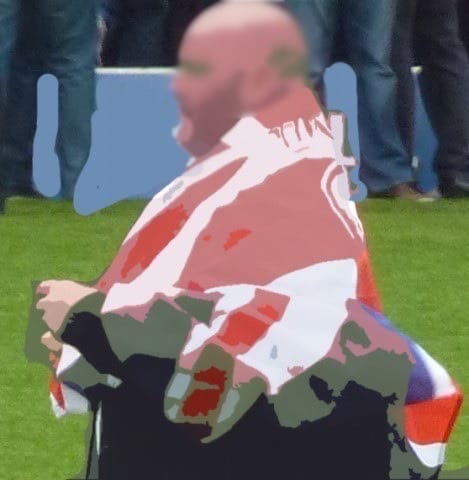
    Post-production image of a bald man with a union jack or flag or whatever you call it over his shoulders

    The fact that he wouldn’t talk to me much more after this, until Christmas Eve at least (and this was two months away), meant that the loss was all his.

    It’s a smashing street really where I live. It’s leafy, but it has an underpass beneath the motorway down to the river-front. Between these two points were two miles of shops and pubs all of which have residential flatlets above them. Lovely.

    I ran a shop at the motorway end, or as the older inhabitants called it “the Meadow Lane End” – cute isn’t it? It’s not. It’s one of those names given to pits of debt by local authorities. Not a meadow in sight. Not even a tree.

    My shop sells electronic equipment, secondhand records and computer games, televisions, you know the rigmarole. It’s dowdy, smelly and does not encourage browsing. I don’t encourage browsing, I don’t even encourage spending that much. However I do make my money from the shop. I pass people through it – the new gadgets. Everybody wants one sooner or later and for a variety of reasons.

    I like to think of myself as an amoral kind of gent. Well suited to the modern age. Capable of coping with emotional and unemotional situations. Able to empathise, sympathise and distance. I don’t do drugs, I do drink a lot. I gave up smoking last year. I like to think of myself as literate. I do a lot of my own research into important matters. I pay tax. I am heterosexual.

    My name is Wayne and I’m 29 years old. I am a depressive – bi-polar but I don’t take Prozac, Lithium or any of the others. I exercise and keep busy, when I get suicidal and steer clear of the drink and watch black and white movies – mostly “Bringing Up Baby” which bears no resemblance to my life or that of anybody I know. I like the way that Cary and Katherine really want to find reasons to avoid the obvious happiness that awaits them. I often cry for no reason. I am not a likeable fellow and have destroyed at least two dead cert relationships with malice a-during-thought.

    Self-pity is huge with me. I seek out biographies of self-pitying folk. I avoid actual self-pitying people though. My self-pity is fuelled by mediocrity. I never wanted to be mediocre. It’s not my fault.

    Anyway, back to Bryyyannn. He is one of the chaps who comes into my shop to try to sell me things. Brian has no chance whatsoever of anything. Brian will never even win the lottery. Brian is a deadman walking but no thoughts of suicide ever mug him mid-beer. He’s too thick, he’s a moron with more yelping sprogs than braincells.

    He’s a big lad with a t-shirt, a Ford Escort, a CD-player and a colour television. He depresses me more than any of my own internal, bad chemistry ever could. Because Brian just keeps on surviving and I have no idea how. All that’s reasonable, holy and rational dictates that the 16-stone, wannabe American, shit-shoveling, shit-eating, shit-looking, shithead should have turned up his toes years ago.

    But then again, I have trouble working out how he learnt to drive let alone how he makes it through a month without starving to death, walking into a glass door or simply exploding with the inward pressure of so much thick-as-shittery.

    Now, it’s fairly apparent to me that the reason I don’t kill Brian is that I need someone worse than I am hanging around my life. Well, yes. But it also has a great deal to do with the fact that I’m a coward and I’d probably get it wrong. I fantasise about it though; machetes, machine guns, knives, poison, drowning, car accident, drug overdose. But I don’t do it. I give him work instead, and he lets me down. So I insult him in the pub, behind his back at all times.

    Tonight though, I hit him and he tumbles. It doesn’t make me feel any better. There’s only one thing that ever makes me feel better, and that’s money.

    I worry about money all the time. I never have money although I spend it. I scrounge with no compunction. It’s the only way.

    Once, when I was younger, before the relationship problems, I asked the deity to let me have love not money. I was standing at a bus-stop opposite Bow Church in the City of London having just walked out of another interview for another job. I’d smiled and talked the talk and thought to myself that this was too much mammon for a young man and knew that I hadn’t got this job.

    I tossed up my options and tried self-pity with God. This was during a period when I searching for my own soul. The speech was along the lines of: “I don’t want the money. I want love. I can live without money but not love”, kind of thing.

    That prayer has always stuck with me because when I did get a soulmate, all we ever did was argue about money until the sense was screwed out of it all.

    I was so young. Innocent. Dumb.

    The deity obviously meant: “Look, you’re no good with relationships, go with the money”. I talk to God a great deal, without of course, having any belief in him.

    I simply like to hedge my bets and he’s about the only one who is anywhere near me in terms of ability. You can’t second guess him. He’ll fuck you. Or if he doesn’t then fate will. And if that doesn’t get you, well Karma will, and if that’s not the case then pre-ordination will. Or there’s the class-system. There’s always a reason and there’s always something to go wrong.

    I’m concerned at this time with making a lot of money. I mean £100,000 or more if the thing plays out as well as the planner thinks it should. Then I can get some good therapy that will enable me to spend some time talking about this condition to someone else. That will then enable me to make some more money until eventually I will be able to kill the condition and get on with having a relationship, travelling the world and killing Brian.

    The planner is a Mr Hughes who does come from Wales, from Swansea I think. He’s like the rest of us but with more front and a 15-year old Jaguar just like you’d expect. His quirk is magic. Mr Hughes believes in the power of timeless and eternal external forces. Go figure. Mr Hughes wears a green suit with brown brogues and never carries jewellery. That surprised me because he just looks like the kind of 50-year old who loves baubles. But Mr Hughes’ Jaguar is under-stated. He sees himself as a planner, and planners never are more concerned with the life of the mind than the trappings that come with a successful plan.

    I’ve worked with Mr Hughes before on a small con in Winchester. What a cutie of a county town that one is. We put up in one of the outlying villages, a small hotel on the riverbank, quiet and alive with the local pool competitions, barmaid chats and under-18s on the run from sobriety.

    The con was a simple one that revolved around charitable contributions to an overseas fund for poor children. I was the aid worker who’d seen it all in Senegal or Cambudidiliia or wherever. I’d come to Mr Hughe’s attention via a mutual friend called Paul Gorse who smoked too much hashish and saw the delivery of beans on toast as some sort of sacred event. Lovely bloke. Such a shame what happened to him.

    Mr Hughes is a tall, tall man and skinny. This means that he’s always cold and forever shivering. It also doesn’t help that he’s smooth skinned like a down-hill bike racer or a girl. He’s got olivey skin with a brown birthmark or mole on his left cheek. He likes to plan cons and he likes to watch them happen.

    He also likes to take heroin. He tried to get me to have a bash when we moved to our second job – he claimed that it would lead to a greater mutual understanding and also provide me with much needed motivation to make the cash that we both loved. I thought he was trying to fuck me and then control the supply. I told him. He cried. We moved on.

    The Winchester con involved shagging a liberal but cash-wealthy company out of cash that they would have thrown away on charity anyway. Simple con; all you need is a video, Mr Hughes’ London contacts for a decent piece of letterhead, some suitably heart-rending letters, and the right time. Mr Hughes knows this kind of thing. He’s aware of the moment.

  • Sports: for People Who Hate Sports

    Any Winter Sport is immensely entertaining because it will show you people far more wealthy than you will ever be injuring themselves badly.

    You don’t get “sports”. Who can blame you? School sports were terrifying and full of equally terrifying teachers and students. Post-school sports, for you, are dead times, moments murdered by inanity.

    Sports talk reminds you that Hell is other people who insist on talking about sport. Follow this quick guide to discover how you can be in charge of the conversation with hardly any work and no real knowledge.

    In order to steer any conversation, pub or bar time, car or plane journey that is being ruined by a Sports Fan (I have to admit to being one such) you only need to know a few  handy pieces of info. This handy list will enable you to derail conversations like this in several countries around the world. Make a note of it, you will find it endlessly useful.

    Cricket

    Parents are wrong. It is possible to eat a full meal (or in the case of cricket, two full meals of lunch and tea) and then immediately run around outside without dying from cramp. Change the subject to food.

    Soccer/Football *TOP TIP

    Falling over in floods of tears and holding any part of your body can sometimes get you a booking: this can also work with hard-to-get-into restaurants. 

    Baseball

    Legendarily, the Inuit people have billions of words for “snow”. The same can be said for baseball players and fans when it comes to throwing a ball. The curveball has at least 1,000 names including: “Yakker”, “Yellow Hammer”, “Drop Down”, “12-6”, “Bender”, “Uncle Charlie”. Change the subject to language or other cultures.

    Rugby Union/Gridiron

    Rugger and Gridiron, are fabulously interesting sports now please may I leave this pub/bar I appear to have stumbled into and may I have my trousers back and could you stop lifting me off the ground and throwing me like a dodo egg, thank you.

    Rugby League

    Rugby League is played in New South Wales, Australia, especially in Sydney. There used to be an excellent pub called The Excelsior with a pool table, live music, interesting clientele, and very decent beer in Sydney. It’s now serviced apartments. Don’t let that stop you changing the subject from Rugby League to live music, travel or serviced apartments.

    Tennis/Squash/Badminton/Squash

    King Henry VIII invented Real (e.g. Royal) Tennis at Hampton Court Palace as a way of sorting the wives from the corpses (hence 15-Love). The game morphed into several other racquet-ball versions all of which have the same things in common: they are played on Courts (as in Hampton), watching them can end your marriage. Change the subject to famous buildings or divorce.

    Winter Sports

    Any Winter Sport is immensely entertaining because they are all based on people far more wealthy than you will ever be injuring themselves while dressed stupidly. Change the subject to Christmas, eggnog and the fact that everything is going downhill fast.

    Lacrosse

    Seriously? Change the subject to anything you like involving catching things in your shopping basket.

    Cycling

    The original bicycle was invented by an English woman who left the country because opium, absinthe and other drugs were easier to get and higher in quality in France. The lady’s name was Penny, she would ride from one end of the Left Bank to the other daily, singing ‘God Save the King’ and smoking Gauloises. People now watch cycling for the drugs.

    More soon…