In which DuoLingo gets short shrift.
Let me begin like a churl. The Irish language (Gaeilge) is far from the beautiful, lyrical, poetic encoding of deep emotions and profound contemplation that some non-Irish speakers might like to believe. It’s a right bastard of a tongue to get your mind around if, like me, you’re a native English speaker.
However, once you’ve even the slightest inkling of what’s achievable with the grammar, the structure, the dialects, the aliveness of Gaeilge, even a sub-surface scratch of an inkling, the language is capable of rearranging the way you look at people, things, relationships, welcomes and goodbyes.
Before we go on, I have an admission. My first attempt at learning the language was back in the late 1980s when I lived in a suburb of Dublin for a few months. This is a long and sad story of lost love and family secrets, which I won’t tell here despite my deep joy in tangential storytelling.
Long story short though. Back then I hung around with students and ex-students from University College and Trinity. Intelligent, curious people, only two of whom spoke Irish. That pair were from Donegal.
Irish was a curiosity at best or more commonly it was more a lament of ‘Man, I hated it at school’ a keening for what was then considered to be the lost hours of youth haunted by the ghost of Peig: A Scéal Féin, “Peig: Her Own Story.
My latest effort to educate myself in Irish began after the debacle that is Brexit had begun to cast its foul shadow over us Brits because of the idiocy of us English and Welsh. Of course, I started with DuoLingo.
A caveat: if you really do feel that you need to know phrases of such utility as:
“D’ith mo thíogair an t-úll ar lá scamallach ach grianmhar i gCluain Aodha le mo dheirfiúr Pádraig”, which roughly translates to, ‘My tiger ate the apple on a cloudy but sunny day in Clonee with my sister Patrick’, then I take it all back, DuoLingo is for you.
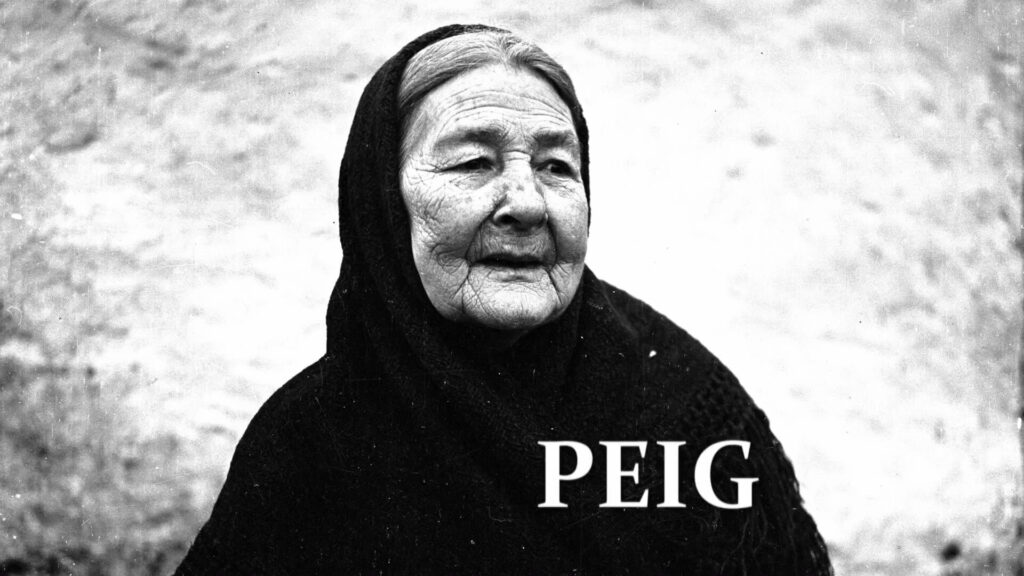
Máiréad “Peig” Sayers – her words evoked tears. We’ll talk about Peig in later installments.
Soon I realised there are dual Irish/English language books, children’s books! Books that made far more sense than the A.I. infested Eire of DuoLingo’s hallucinating bullshit. Books available to me.
Dual language books are great for the sedentary learner. Also better than Duolingo or Rosetta stone are the growing arsenal of podcasts so rich and compelling that you might want to listen even if you’re just interested in languages.
I’d recommend kicking off with the chatty, informed, entertaining and now sadly discontinued, although you can still download it: Motherfoclóir and its accompany book (Motherfoclóir: Dispatches from a not so dead language) by the inestimable Darach O’Séaghdha.
Less specifically, I found that podcasts by people who speak Gaeilge to each other on a regular basis helped immensely with pronunciation. Pronunciation that differs between the three main dialects, Connacht (Cúige Chonnacht), Munster (Cúige Mumhan) and Ulster (Cúige Uladh). One of which you’re going to have to choose from if you don’t want to lose your mind and give up within minutes.
Obviously, I know but I took and still take a huge joy in finding my way from one end of the word ‘Comhghairdeachas’ to the other before I gave myself any Congratulations.