Tag: Family

  • Factual Work

    What follows happened. In real life. There are stories here that feature love, death, the Irish language, work and much much more.

    • Being Questioned About the Death of My Child

      It was a case of good cop… I was living in Sydney, Australia the day that my daughter died of a combination of pneumonia, a badly administered anaesthetic following dentistry work and her cerebral palsy. She died in the bedroom next to mine. I discovered her in the morning. She died in July 2005. Twenty

      Read more

    • A Crumb Goes To Work

      My empty soul, my hypercritical mind assure me everything will go wrong. I’ll go wrong. My inner voice seemed to be that of a whiney teenager. I’m 60+ years old. Until a few weeks ago I was a KP (Kitchen Porter) and ‘potwash’ – the lowest form of life in the professional kitchen. It was

      Read more

    • Insomnia & Madness

      Occasionally, a young, green, wet-behind-the-axons, an eager junior nerve ending is thrown into the fight, only to be made cynical and bitter the veteran funiculi in its weary fascicle. Real insomnia is a relationship wrecker, it’s a straight road to madness, it’s a hallucinogen, it’s a soul sapper. So, where’s the fun side? I sleep

      Read more

    • Learning Irish – An Introduction

      Before I begin, there’s one thing that I have learnt about myself from this whole thing – and it also explained something to my wife about me. I tell long, tortuous stories where the story itself is less important than the ending.  I always have, tá brón orm faoi sin (I’m sorry about this). Apparently

      Read more

    • Learning Irish – Part 1 – Duolingo sucks

      In which DuoLingo gets short shrift.  Let me begin like a churl. The Irish language (Gaeilge) is far from the beautiful, lyrical, poetic encoding of deep emotions and profound contemplation that some non-Irish speakers might like to believe. It’s a right bastard of a tongue to get your mind around if, like me, you’re a

      Read more

    • Learning Irish – Part 2 – Why bother?

      “Don’t worry about this when you get started. Most Irish speakers won’t snap your head off for stumbling over a few intricacies as a learner”. “No one speaks Irish anyway, what’s the point in learning it”. I also look at my encounters gender and I encounter the seemingly terrifying síneadh fada. Many of the reactions

      Read more

    • Learning Irish – Part 3 – Fear & Bean

      I’ve been to Irish weddings before in Dublin, Borris and Athlone. Back then I had no Irish to speak of, let alone to speak with. Here’s a fun fact. In Irish the word ‘Fear’ means ‘Men’. ‘Bean’ means ‘Woman’. Now there’s a valuable lesson in not falling for false cognates. These are words in different

      Read more

    • A Childless Father’s Day

      It took me a while to face the fact that I couldn’t stop being a father after my child passed away. Mark Zuckerberg’s mad plan to pay-per-zombie our loved ones wouldn’t have helped.

      Read more

    • Darwin and the Aborigines

      What you have to understand is that Darwin, unlike the majority of Australia, has a very visible Indigenous Australian population.  I once had a conversation in a pub in Darwin, in the Northern Territory of Australia, during which I was threatened with a beating and told that the indigenous people were happier and better off

      Read more

    • In the Morgue with My Daughter

      “Say it out loud”. I spent quite a while, swimming in drink, tied to the house like a wheel on which I was slowly being broken.  Writing fiction means drawing on your life from time to time. I’d been writing a short story about a mortician. I took a break and I was back at

      Read more

  • Being Questioned About the Death of My Child

    It was a case of good cop…

    I was living in Sydney, Australia the day that my daughter died of a combination of pneumonia, a badly administered anaesthetic following dentistry work and her cerebral palsy. She died in the bedroom next to mine. I discovered her in the morning.

    She died in July 2005. Twenty years ago. She was called Zuzu and she had a form of cerebral palsy called holoprosencephaly. It’s a rare and extreme version of CP. Zuzu was fed by tube. She was unable to sit up or speak. She couldn’t crawl or do anything really other than be happy unless people were being angry. She was very, very happy.

    “Zuzu’s condition was extreme wasn’t it Tim? That must have been very hard for you…”

    We loved her very much indeed. Once other people had got used to her drooling constantly, and her tube button in her stomach, and the fact that her life was going to be a short one, they grew to love her very much too. People are scared of all of those things and more with disabled people.

    Lots of things about disabled children – especially kids with such extreme and obvious disabilities – make people very uncomfortable.

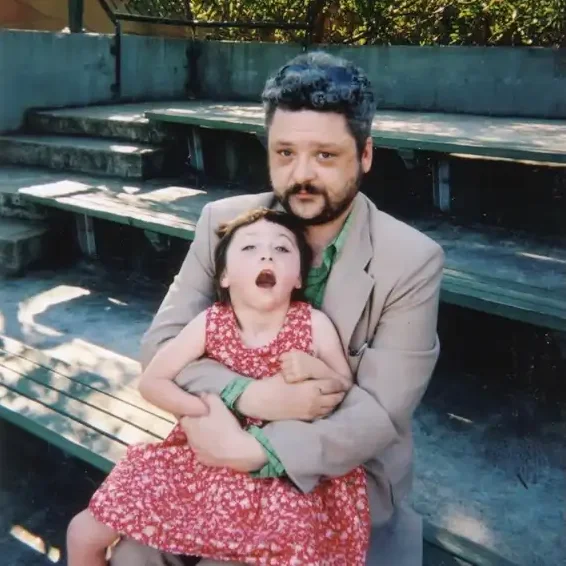
    Tim and his daughter at Taronga Zoo in Sydney.
    Tim and his daughter at Taronga Zoo in Sydney.

    I had separated from her mother a year before Zu died. But we were on good terms. I would look after Zu for two weeks each month, and her mother would care for her for the other two weeks. There was some flexibility in that schedule. The night Zuzu died, my ex-wife was over at my place, we chatted. It felt a bit like we could have patched things up. We didn’t.

    I am writing this now because time has passed. I have moved back to the UK, I have a new partner who I love. My ex-wife is still in Sydney with her new partner. She and I Skyped this morning.

    “I bet it was exhausting too, wasn’t it, Tim?”

    This forced me back in time to a police station in Balmain. To two rooms in that police station: I was in one with my interrogator. My ex-wife was in another with her interrogator. This was four days after my flat had been turned into a crime scene, which always happens in the case of a sudden death at home, I had been told.

    My officer, a woman in her late 20s. I forget her name. We hadn’t been arrested but questions had to be asked. Her first question was:

    The room was on the ground floor of the police station in Balmain. I was on one side of the desk, I think it had a green formica-like surface. There was a window, maybe a metre square on my left.

    I asked the policewoman to repeat the question because I honestly didn’t believe what she was trying to get at. Everybody knew I loved Zuzu. But bringing her up had been hard, she was right. Other kids were running around, walking, talking, saying that they loved their daddy and mummy way before the age of 7. Other kids didn’t make people haul their kids away in some irrational fear that CP might be catching. Other kids weren’t fed by a tube in the stomach.

    She repeated the question and I replied, “Yes, very hard sometimes.”

    She left the room to get me a cup of coffee and some tissue paper and left me to think…

    I’ll write more about this later.

    Meanwhile, here is the precursor.

  • The Assumption – Chapter 4 The Four Crosses Hotel


    The train remained empty or near as damn it. I played a disco compilation that reminded me of good times before when my hips fragmented, back when I shimmered and moved like molten crystal, when I was “an impossible achievement of grace and instinct”. Neil O’Neil, doctor of medicine so he claimed, said that last bit one night in Berlin or Buenos Aires, somewhere cool anyway. He wanted me so badly back then. I thought it was all a bit twee and heavy handed. Give me a ride in a private jet, a chug on some Juglar Cuvée, a snort of coke and I was probably yours for the night.
    I wouldn’t have known true admiration if it had lapped at my fingers and died for me.
    As the train rocked along, I drowsed, and rain started to pour down. I remembered the last thing my probation officer had said to me before I left the house. I’d told them I was going to Ireland to reconnect with my roots, relive beloved memories of family holidays. He reminded me that I needed to check in with the Garda Síochána every day. I’d said yes of course I would.
    “Oh, you’re going to Ireland, I’m very envious”, he’d enthused. “What a magical island. All the marvellous characters you meet. Wonderful, just wonderful”.
    He stamped and signed the documents that I needed to be stamped and signed.
    “God yes”, I said.
    “Magical, magical place”, he sighed dreamily, “I’ve been there once”. I looked deeply into his eyes, which he always enjoyed. I saw a weekend in Dublin. I saw the Book of Kells and Trinity College, the GPO, The Guinness Storehouse, St Patrick’s and Christ Church cathedrals, for Christ’s sake I even saw a snap of the white of Kilmainham Gaol where bad things had happened but let’s not start another fight over that.
    I saw him ordering a Guinness and settling down near a roaring fire to listen to a group of relentless musicians bloating out rank Victorian folk music with fiddles, tin whistle and a bloody bodhrán. I didn’t hear mentions of ye Black and Tans, of The Boys of Kilmichael, of The Valley of Knockanure and definitely not The Men Behind the Wire. He’d never been in any danger of hearing rebel songs, so he was unable to imagine them. Fair play to Dublin’s tourist industry and its extraction of the pounds sterling.
    I missed Ireland. I’d had good times there by the sea. Neil O’Neil had family there. He called them family anyway. Down between Cork and Waterford on the coast. Nice family. Lots of fine, fit lads.
    A father and mother you didn’t ever want to get on the wrong side of. Especially came to the lads.
    Shame I couldn’t go back, but people get murderously angry for all sorts of reasons in countrysides the world over. Culchies, Westies, Hicks and Bumpkins have spacious memories for even the slightest of grudges, and passing murderous grudges from generation to generation is both sacred and very, very popular; like watching soap operas or sports.
    I woke up gently and easily as the train pulled into Crosschester. I stepped off the train into what I remembered as an inelegant, soot black bricked minor Edwardian railway station.
    Crosschester station was brighter and cleaner than I remembered as a teenager when I’d hide there. Now I walked past shops selling socks, and other ones selling ties, and other ones selling books, sandwiches and drinks. Even the lavatories seemed from the outside at least to be hygienic and unexciting. Quite unmemorable.
    My cloudy, or clouded I should say, recollections of Crosschester were drenched tediously in cheap beer, cider and spirits, all of it wreathed in cigarette smoke. Everything was soundtracked by pop songs, three minutes, sediments of sentiment sucking down bonfire smoked autumn afternoons into evenings into nights until all time folded into no time at all, no time left. A school for all the other cities and towns I eventually lived in. The tunes and the flavours changed. I tried to keep my head down. I wanted to get out of the station fast, as I didn’t want to be recognised by people, unlikely, or by ghosts.
    “You toothsome little morsel” either that or the sound of the train pulling out. Every town has a voice doesn’t it? Someone’s voice, ancient or modern. I was shocked if this was in Crosschester though. I put it in Porthampton, down by the sea looking to France, not this backwater looking into itself. So, as the new fall bonfires of Crosschester draped damp smoke on me, I walked down Station Road towards town and to the Four Crosses Hotel. This was the address on the letter given to me by Jimmy the Phoenix in prison. I summoned up Dr Neil O’Neil’s voice.
    “It’s cruelty to spend a day out in the harsh light of the world when you could be with your pals in the warm glow of a bar”.
    Crosschester station was on a hill so I could see the cathedral that dominated the area and gave it its status as a city. Nearly a thousand years old; spiky and arrogant like the Normans who had designed it, it retained the martial glamour it had been designed to project. As I got out of the station, a gentle rain began to fall. As is usual with remote English stations, there were no taxis congregating outside. I did not have to wait, instead I set off in a brisk walk down town. This took me past brick built houses colonised by strangely coloured mosses and lichens. Their walls sweated onto pavements that were already saturated. I walked by several churches that looked warm and dry inside and I heard hymn-singing parishioners whose harmonising voices rose into the evening reminding the singers and me of childhood assemblies.
    I was not tempted to join in.
    I am tall so I strode down Station Road at what must have been a comical angle to a humorous observer. All tall people stride, it’s bestowed on us in the same way as portly people roll, and lithe people pirouette. I must have looked like a back-slash in the falling water. Just about retaining uprightness. The opposite of my real life.
    The rain descended into a cloying mist. No thunderous drenching downpours for this city. There’s nothing so déclassé as a loud, invigorating drama in the seats of country gentlemen, circuit courts and storied cloisters, towns and cities like Crosschester that dotted the English countryside impregnated with the upper classic stench of Norman conquest. I pulled up the collars of my camel hair coat and pushed on, thankful for my sturdy boots – the kind that never went out of style. I was actually happy to be outside and walking.
    There I was, a Modigliani misplaced in a Whistler painting, striding past a school that had maintained its signs for Girls and Boys. I walked past a sweet shop with colourful plastic candy jars in its wide bay window, something from a Charles Dickens’ postcard, something for the tourists, it hadn’t been there when I was young enough to care. Over the road I saw a policeman looking into the window of a florist, a damp romantic. He didn’t see me. The early fall evening was doused by orange street lamps. Unfit for brightness they only hinted at safety as the night drew in. In other words, it was getting dark. I was scared of one thing in this tiny town that always acted above its station.
    If I needed to avoid going into the next pub I came to for a stiffener, and subsequently socialising and consequently going back to prison. I needed to find The Four Crosses hotel with ‘Owner, Mrs Maeve Morgen’. I vaguely remembered where a building with that name had been when I was growing up so, head-down against the rain, I sped up.
    I strode past a woman walking with her small dog up the hill against the rain. Both of them looked extremely happy with their endeavour. I walked past three pubs, any of which I could quite happily have spent the rest of the night in. Very smart they were. Down and down into the guts of the town. I love going down: stairs, rollercoasters, escalators, even in planes I love the bump of landings. Going down and going down fast just works for me.
    I should have said ‘The City’ because, despite its having become a tributary of the mainstream of English history centuries before my wet descent, the cathedral granted it the right to call itself ‘City’. Crosschester was and is a city in the same sense that the lady with the dog were mountaineers.
    Station Road ran into Great Hall Road into Jewry Street and St James’s Lane, which terminated in a square of commercial buildings. The Four Crosses stood on its west side. Four storeys and a well polished, deep red set of double doors were guarded by two fat white pillars, tapering at the top and bottom rather like two giant porcini mushrooms.
    It looked like the kind of place where you’d expect a doorman dressed like a Generalissimo to be stamping his feet and blowing into his white gloved hands. Instead there was an A-board that read: “Visit our **** restaurant – family deals assured – eat alone or with a friend!” I was hoping those symbols were supposed to be stars and not redactions. In I went.
    There was nobody at the front desk of The Four Crosses so I headed into the bar. It was an amalgam of familiar places. The bar was made of highly polished oak with a brass foot rail that was a stage to anger or anxiety. It had four unpadded, high-stools in front. It reminded me of several small, ‘members-only’ bars. One was up a tight flight of filthy stairs in London’s tawdry Soho. Heterosexuals, homosexuals, pansexuals, asexuals, too-often-drunk to be sexual, and a very grey man in a very smart suit, rumoured to be ex-MI6, all fused with the furniture.
    They drank Dubonnet and gin, maybe whisky and soda, which they called a Tom Collins and drank in dirty highball glasses. One or two of them still drank port and lemon. These drinkers were deeply acquainted with each other. A perfectly loose knit family. A before or after friendship to be treasured. They reprised the performances of characters they’d judged wanting when they first stumbled into the bar. A long time ago they were young and curious about the hidden dangers of a capital city. Sooner or later, with the inevitability of rotting apples into cider, they ended in each other’s arms or at the end of each other’s fists. Then they did it all again the next day.
    The Four Crosses had the same turgid energy without the excitement of the city outside.
    The general layout reminded of another members-only club, under the ground of Sydney’s Macquarie Street. Used and abused by lawyers, tabloid hacks, Japanese businessmen, elderly gay Kiwis, and people like me: tasty and gratifyingly expensive accompaniments to someone who dabbled forgettably in elicit sex.
    That it was subterranean combined with its thick Hawkesbury sandstone walls to make it a cool place to have a few quiet ones in the heat of a Sydney afternoon. You entered its gorgeous, deep red gloom down a steeply spiralling staircase. Signed in a velveteen covered book using any old name. Paid five dollars to a tall, elegant, beautifully spoken Vietnamese-Australian, maybe a man, maybe a woman. Sometimes they’d stop you for a soft chat, during which you found out that they were definitely Vietnamese, and came over as a refugee. He discovered all sorts of things about you that you never really knew you were letting on to. Then you walked through a crimson and cerulean beaded curtain that shushed and sizzled behind you. You were in the perfectly square bar.
    It had no sex to it, no musk. Instead it had cigarette smoke and low volume horse racing commentary on one TV. It had a betting booth, a T.A.B., lurking and ready to pounce in a corner near the rest rooms, perfectly placed for the desperate.
    You could also get absolutely wonderful Japanese food there. The menu changed according to whatever went through the cook’s mind. No one ever saw the cook. No one ever heard the cook. Rumours riddled the walls that he had Michelin stars but was shamed from Europe for reasons of Bisto. Or she was a humble but miraculously talented Japanese okaasan; old, wise and once a comfort woman who kept to the shadows feeding strangers with all the love she herself had never felt.
    I loved that food served in plastic bowls on low, square formica-topped tables. I loved its selection of wines, spirits, beers and poppers. It sighed with gossip, gossip; gossip that I didn’t understand but nevertheless listened to. A pick-up was almost guaranteed. What a place! What a digression.
    Finally it took me to a bar with crumbling, honey coloured walls on a corner near the canal in Villette, Paris. Card players, newspaper readers, solitary shady men and women, shades, low voices, a magic jukebox. You were left alone no matter who you were or who you were in the company of. There were none of the characters that proliferate in other dives. People didn’t drink there as a performance or as a last resort, a replacement for love. Dr Neil O’Neil was a character. I drank in Villette to escape him.
    What set the bar in The Four Crosses apart was that embedded in each wall, north, south, east and west were the heads of animals. All in beautiful condition. A fox to the east, a rabbit to the west, a deer’s head behind me to the south. The eyes of each animal were wide open and bright. Except for one. On the north wall behind the bar, with her left eye shut in mid-wink was the head of hare.
    I breathed it all in, like it was a broken home to me. I wished I still drank alcohol.
    One of the men at the bar looked me up and down and said in a tobacco gravelled voice, “Don’t you worry. She’ll be down toute de suite to check you out”.
    “Check me in?”
    “Yes, that too”, he returned to his conversation.
    I was tempted to buy a drink. Just to see, and because the bar and all the bars before it insisted. It would have been so easy to join those others at the bar. They would have found a stool for me and my money. They would have slotted us in. Drinker was my first adult identity even before smoker, and quite a way before druggie. It tipped me over the lip of innocent adolescence into hellscape escapades. Sodden memories. Sodding memories. All the best places, all the best people, the best sex, the best stories, all of those are glamorous cocktails or dregs of other people’s glasses. I had no blood, sweat, spunk or tears. I was drink. I was drugs. I was wasted and I was waste.
    I didn’t take a drink. I wasn’t open to death.
    “Mrs Maeve Morgen, landlady, hotelier, entrepreneur, very pleased to meet you”
    A middle aged woman appeared behind the bar. She wore a fitted green dress made of a fabric like tapestry. She had jet black hair built up like Elizabeth Taylor’s. Her face was peach-fuzzed. Her sharp blue eyes were made up like Cleopatra. I noticed that her hands looked beautifully, frighteningly strong.
    “Here, this is for you, on the house, to say welcome to The Crosses”, her accent was Welsh. Her voice had authority.
    She handed me a vodka and soda with ice and three thin slices of fresh and unwaxed lemon.
    “I don’t drink, I’m sorry”, I added the apology because I was in England.
    “Oh, treat yourself, you’re in a hotel; you’re on holiday after all. Cin! Cin!”
    “When I say I don’t drink, I mean that I’m an alcoholic”, this usually lead to embarrassed mumbling or even silence.
    “You only live once”, said one of the locals gaily.
    “Enjoy life while you’re in it!”, said another.
    “I’ll have it if you don’t want it, eh Maeve?”, croaked a third from the chorus.
    Vodka and soda with three perfect slices of unwaxed lemon; three clear ice cubes. A pristine highball glass. It was so perfectly hateful. Trapped in the ice cubes were hours of rage, mayhem and regret waiting to escape via the medium of me.
    “I really can’t go back now, not after all the work I’ve put in”, I said firmly.
    Mrs Maeve Morgan took the drink back and said, “Of course you can’t. Once that grey prison pallor’s gone, you’re gorgeous. I respect your decision.
    I didn’t bat an eyelid at her prison barb. Jimmy the Phoenix had given her the heads-up on me, obviously. I just nodded.
    “Course you can’t drink it. Not after all the work”, said the first drinker.
    “That would be a waste of time and energy”, said the second.
    “Can I have that now, Maeve?”, chorused the third.
    Maeve tipped the drink away, lifted the bar flap and stepped into the room. She had legs from the golden age of Hollywood. “Now let’s get you booked in”, she said. We walked into the foyer and to the front desk.
    She stood behind the front desk and pulled out a blue velveteen covered guest register. My name was already there on the top of the page.
    “You have a room at the top with a lovely view over the town, sorry, the city. Everything is paid for. And you have something for me.” Not a question. I handed over the envelope I’d been asked to deliver.
    “Oh, very good, very good. Many thanks.” Maeve sliced it open with a stiletto knife she had too readily to hand. She read the contents, a single sheet of thin paper with writing on one side, handwriting, thin and large, it showed through. She replaced it in the envelope.
    “We can talk about this later”, she said. That surprised me. I had no idea the contents concerned me in any way. I nodded anyway. She nodded back.
    She rang a small bell. A very short, stocky woman dressed in classic red bellhop uniform shot diagonally across the chequered floor at speed, and picked up my suitcase.
    “This is Little Cartey, she does everything around the place. If I passed away tomorrow, no one would notice the slightest difference to the running of The Crosses as long as Little Cartey was still around”.
    The two women smiled at each other, and Little Cartey walked over to the elevator.
    “This way, off we trot”, she said over her shoulder.
    I walked over to the elevator where Little Cartey was waiting. She pressed the Up button and turned to me.
    “What do you do?” She was direct during our first meeting. She had a Crosschester accent, north side. She said, “Traat” not “Trot”. It reminded me of nights out, gigs, kissing, fingering, cider.
    “I travel, mostly for business.”
    She nodded and pressed the button again.
    “Come on now you old bastard”, ‘baarstard’, she was talking to the lift.
    I heard the elevator grinding its way down apparently in a mechanical agony. Little Cartey looked up at me. She had brown eyes, wide and inquisitive. They didn’t look like they’d seen many tears.
    “Travel must be interesting. Not done much myself”. She sounded wistful. We waited. I expected her to whistle a tune. She didn’t know I liked her. The elevator groan got closer to us. I was drawn to Little Cartey almost immediately. Back then I didn’t know if this was self-preservation, a prison trait; or true love. I fall easily.
    Eventually the tortured grinding stopped and the lift ground to a halt. Little Cartey slid back the protective metal grill.
    “That’s supposed to stop drunks falling down the shaft”.
    We got in and while we travelled, Little Cartey continued interrogating me.
    “Do you enjoy what you do, then?”
    “Mostly. It’s been a long day for me”
    The elevator continued to rise like an old man from an over-stuffed armchair.
    “You’re not a lawyer then? We get a lot of lawyers in for the crown court”, she paused, “and the ecclesiastical court too, obviously”.
    I shook my head and tried to look tired.
    “Thought not, you don’t look like a lawyer. Anything but actually. You’re on your holiday then?”
    I really wasn’t used to questions. Questions happened before you went into clink. Questions got you in there. While you were in there, no questions were good questions. Curiosity was frowned on. If someone had questions, you knew you couldn’t trust them. Or they already knew the answers, and you really didn’t want that.
    “How do you mean, I look like anything but a lawyer?”
    “Oh, you know what I mean.”
    She had a pleasant smile. I liked it.
    “Oh, I think maybe I do”, I smiled back.
    “Come to see the cathedral, the college, Mizzmaz Hill, the lido, all the historical gubbins?
    I shook my head.
    “Really? Not work? Not touristing?”
    I shook my head again. Smiled. It was a game. I was out of prison.
    “Oh! You grew up didn’t you? You’re from Crosschester! You’re doing nostalgia!”
    I might have flinched a little.
    The elevator was taking forever. Its groaning was painful. It was technology but old technology, it lived in two worlds.
    “People come to do funny things in hotels don’t they?”
    “Hilarious things.”
    “Sad things.”
    “Tragic things.’
    “Filthy things”, she grinned.
    We stood waiting like a pair of old hospitality sages. We smiled broadly at each other like good old friends. We’d made a definite connection although we didn’t know quite what kind.
    Finally the elevator came to a spine taunting halt.
    “Off we traat then”, said Little Cartey.
    She picked up my suitcase and turned left outside the elevator. We walked down or up a spectacularly long and garishly carpeted corridor: poppy red, daffodil yellow, the purple of the orchid called Dead Man’s Fingers she told me. Finally, she opened a door and we went into to my room. I offered her what I considered to be a very reasonable tip. She pocketed it eagerly and left, shutting the door behind her.
    “If you need anything, just yell… for me, just me”, she called through the thick wooden door.


  • The Assumption – Chapter 3 Training Daze

    I got off the train and walked across the concourse of Porthampton’s huge main station. I kept my head down. You never know who might recognise or remember you from some bad time in your life. The station had been cleaned up, modernised  and heavily technologised since last time I was there. 

    I was been sixteen years old,  drunk on sweet cider and stolen cigarillos. I had been in love with someone, someone grand, my dream, my first love. I was running away from them and from my family. I wore a lot of black eyeliner, my hair was dyed black, my clothes were black and dark purple and dark, blood red.

    Dark music was branching through me from my cheap, bright orange foam headphones. It was September and I smelled diesel oil, and a place with Saturday evening tension. The clouds were ganging together and whispering as they came in from the sea ready for a fight. 

    My first love – obviously also my first broken spirit, trashed soul, devastated heart – had turned out to be less fairy tale prince and more a filthy, angry drunk in their fifties who borrowed money on a no return basis. He used this to stand his round and to get us both high. He would then call himself a generous fella. Then he’d take me back to his flat and submit me to what he called ‘good hard healthy sex’. My first love called me his toothsome teen – that was the word he used, that word ‘toothsome’.

    At the height of the one-sided romance I decided it meant to be eaten alive. That man knew that my looks could be turned into a very palpable (he taught me a lot of words; no right meanings though) profit for both of us. I agreed with all the knowledge and experience of a 15 year old. His penchant, his predilection (him again) for young flesh like my own perfect skin was, he told me, was so he could pretend it was his own. Relive his youth. Understand the young. Empathise. We met at a bus stop near a red post box. My first broken heart came just after a French cigarette and my first court appearance – his fault. After him there was nothing special about being in love. 

    As I waited for a train to take me away, I pickpocketed a student-looking lad more drunk than I was. I got just enough cash for a ticket to Paris and some fags. That was decades ago. 

    The station brought all that back in pieces, so I found a shop that looked like it had what I needed immediately. I popped in and bought a portable music player and a selection of funk, disco, hiphop, punk and Mahler if I needed him. I grabbed a copy of the first broadsheet that came to hand, and hopped on the first train going up and right – everything stopped at Crosschester. Leaving Porthampton was not like leaving Paris, New York, LA, Melbourne, Akra… it wasn’t like leaving anywhere else because it was a place that had impaled me young. Unlike those other places, I had no choice in the onslaught of its memories, rough and painful like its rocky, pebbled beaches. Those other places could be treated as passing fads, drug pasts, drunk pasts, working pasts, made-up pasts. Not Porthampton. 

    I realised that Crosschester and the villages that suckled it were more cinematic, more ingrained, more terrifying during a bright summer’s day than any of those other places could be on a winter’s night. 

    “Fuck it. Fuck it all. Memory is not the boss of me. Fuck you”, I said to little me in a way that sounded exactly like little me. 

    A train pulled in, going in the right direction so I got on. After a few minutes it grunted and complained and made its way out into the weak sunlight. I had two seats to myself. I tried to read the newspaper and let the countryside stutter by the dirty, scratched-up window. 

    I finished the crosswords and tried to read the newspaper but I couldn’t settle to it. Nothing seemed that important to me. Terrorist threats, popstar romances, housing shortages, murders, adorable three legged puppies, recipes with far too many ingredients. It wasn’t as if I’d missed any of this while I was locked up. If you wanted to stay up to date with life outside, you could. I did. So, instead, I returned to the undulations of the county’s green countryside obfuscated in places by angry looking hawthorn bushes, in others by industrial units, in others by matchbox houses until I fell to thinking about Bernadette.

    I used to like her a lot, I mean a lot, almost like a lovely, cuddly aunty. People said that we were so very much alike. This is when I was about ten years old and still a way from blossoming let alone fruition. All the way back then we both liked making other people laugh. We could both sing a little, dance a little. We put on performances at Christmas: we played a ventriloquist’s dummy and the ventriloquist.

    Two shows for the festive period, one on Christmas Eve, one on Christmas Day afternoon. We switched roles. These cute entertainments were not for the sake of pure amusement. The dummy would cruelly tease people watching. We performed for us rather than for the audience. We would mess up horribly and then simply roll it seamlessly into the show – we knew that the gawping faces would never notice. If anything it illustrated our amazing theatrical skills. We shared a general feeling that the rest of the world was just an audience. We never discussed this. We knew it. My take-away from it was how to turn this audience into a paying one. Aunt Bernadette just wanted the attention.

    We grew apart as age withered her and strengthened me, by the time I was thirteen, we were inimical to each other in the world. I remember the day. I was fourteen and she was 150 years old. I had been dropped off for my monthly visit. We were eating lunch and I asked something innocuous about God. Something trite I’d picked up at school that sounded amazing. 

    “Can God create something he can’t understand?”, I helped myself to some more summer pudding.

    “Of course not. God understands everything”, she sipped some port.

    “So, God can’t do something then?”

    “There is nothing God can’t do. You know this Laurie”.

    “He can create evil”.

    “No, that is Satan’s role”.

    “So, there are two things God can’t do. He can’t create something that he can’t understand because he understands everything. And he can’t create evil because the Devil does that”, I sipped from my Coke. I felt good. 

    She stabbed at a block of sweating Stilton with the end of her steak-knife.  

    “We cannot understand God!”, she yelled, exasperated that I was missing such an obvious theological point.

    “You can say the same thing about lunatics, Bernadette!!?” I yelled back, having become fascinated with lunatics as any teenage boy does.

    “Have some bloody respect. I am your AUNT Bernadette!”, she roared. 

    She rose from the table like an avenging angel rising from the corpse of a heretic terrified to death and to Hell. She grabbed a whiskey bottle by its neck, and a heavy crystal glass, she took her cigarettes and stormed out into the garden. I had to laugh. Don’t get me wrong, each to their own beliefs, the more the merrier in fact, but fucking hell, I ask you, really.

    She stayed in the garden, puffing and chugging away until my foster parents came to pick me up. They all had a conversation out there. Bernadette raving and gesticulating, fag-handed and engaged, my meek fosters nodding and shaking their heads sometimes at the same time.

    When we finally made it into the car, my foster father turned around to me, I was sunk in the backseat reading about lunatics. 

    “Are you ok, Laurie?”

    I nodded, and sniffed, not looking up. Of course I was okay, stupid questions. I turned the page. We drove home and I went up to my room. I heard them downstairs, below my bed, muffled discussions, one of them crying. I slept ok that night.

    After that day Bernadette stopped talking to me in anything other than holier-than-thou platitudes, threats of agonising afterlives, and drunken mumbles. I stopped talking to her entirely. I stopped visiting her in her small, fag smelling house in Commiton just outside Crosschester. 

    A few years or maybe a decade later, the foster parents told me that Bernadette had retired early (“Maybe you’d like to send her a card?”, “Nah, you’re alright) from a dowdy job in one of the civil services. Her father – a grandad I never met because, well, I just never met him – had left her a decent sum of money and the mad old big old Georgian house in Shalford village.

    She settled into two or three rooms of the house to drink whisky, smoke tobacco and eat next to nothing but fridge cakes, hot buttered toast, and honey-roast carrots with sweet chilli sauce. Shortly after the local doctor, hectored for painkillers, had diagnosed her with diabetes she recruited Julianna who moved in as her companion.

    I was in Shalford at the time having run away from my first love. I was trying to touch a few old – I was seventeen! – school friends up for funds with no success. I had decided to run away to Europe, so I thought I should say goodbye to Bernadette, my surviving blood relative. Wealthy, surviving relative. That was the day I met Julianna.


  • The Assumption – Chapter 2 My Journey Began

    A few months after Jimmy the Phoenix gave me the letter and I reminded him to give me the money, I stood looking at the front door of what had very briefly been my home: the half-way house. It was a cold Wednesday morning in October with the wind coming in from the east whipping salt into my hair. This would have been a year after we all heroically fought the sickness off. It was around the time when most people were getting off to work in the morning. 

     I had been there to re-acclimatise to things like actual food, going outside, and not sleeping alone. It was a well appointed building, tall, thin, with lots of depth. I liked it. It was very much like me. It was a gothic, red brick; imposing and still mundane. Victorian. It stood in a row with others of its ilk in the middle of the once grand navy town of Porthampton – now gone to seed since the sailors left. Buildings like recollections are never entirely the same even if they’re built by the same group of people, they’re only similar. This one had been a family home, with rooms upstairs for staff. In my room, under a loose floorboard, I’d found a diary written by an over-educated maid. I looked under the floorboard because that is what any sane person does when encountering a loose floorboard. Not doing so shows a distinct lack of curiosity, therefore imagination. Unimaginative people are not fun or useful. You’re one hundred times more likely to find yourself kidnapped if your bodyguard lacks the imagination. Unimaginative muscle isn’t even any good for sex most of the time.

    As I write this section of my story using pen and paper. I am looking out of a window overlooking Dublin Bay – like the Bay of Naples but with fewer calories – and I’m hoping it will relax me. This process is supposed to be cathartic. So far, however, it is anything but. I swear to fuck that I will start drinking and drugging again unless something good comes from this. 

    “Calm down, love”.

    The voice is coming from the other room, no not in the feeble analogy to death, but from the kitchen probably. The voice cheers me up. My love is back from the market with all the ingredients for tonight’s meal. Such a beautiful love. I will move away from this hard seat at my writing table. I will sit and warm in the red leather armchair, drink some camomile tea and try to remember the half-way house, which I should never have been allowed to leave.

    In each of the rooms, in the hallways and staircases some good-hearted person had hung framed prints of famous paintings to raise our consciousness or spirits or eye-lines. 

    I had Ophelia by John Everett Millais in my room opposite my bed so the evening light from the window fell on it. She was floating in a river or pool, ‘incapable of her own distress’. She was either dead or soon to be dead. By suicide or having fallen from the broken branch of a willow tree, the debate rages about that. I often looked at her and thought how good it would be to join her in there, just floating down stream, staring up at the sky keeping company with daisies, poppies and Dead Men’s Fingers. It calmed me right down. 

    Anyway, there I was looking at the thick dark blue door of the half-way home. Someone had pasted an electric pink A4 poster with a picture of a blond man and the words, “He’s Right. Free Him Now!” on it years or months before. No one had bothered to remove it so it had faded so much that the hair was almost invisible while the dark eyes and small, fat lips gave the appearance of a badly made-up clown.  I had no idea if the man was right or free. I hoped he was. I was ready to go. Love crimes and death crimes had all played out inside that building, and a small, cowardly part of me wanted to go back in because it was familiar and about as familial as I’d ever known. That was no longer an option though. I’d agreed to a deal, I had the travel money and the accommodation.

    It was time to forge ahead. 

    That was life in those days.

    Lots of forging ahead away from the sickness of the past.

    I had a few nest-eggs tucked away around the world. Nothing too showy but enough that I was clear of money worries for a while. I’d said my goodbyes and packed up my belongings and the mysterious envelope. I travel light and buy what I don’t have when I get where I’m going. I’d never settled anyway, which made prison life less unbearable for me than for many other people who cried their eyes out with fear, indignation and home-sickness. Home is where the heart is, wherever I buy my hats.

    As I stood there, everything I was wearing was out of date, which rankled slightly. I was wearing a long, camel hair coat, my stoutest, brownest, leather jackboot style boot boots, a dark purple cotton weave suit, with a slightly yellowed polo shirt, long sleeved, Fred Perry. I wiped my right cheek dry. I made sure my wide-brimmed hat was dust free and at a sensible angle. I wore my grey-framed spectacles for clear vision and because of the distinguished air they lied to other people about. I was ready. I was ready for anything.

    So I thought.

    The weather was crisp and clean. The sky is crackling blue. I could feel the weak sunshine on my back as I looked at my crazed reflection in the cracked paint of the door. I made a decision that even now after everything that’s happened I remain proud of. I decided not to look back. 

    Not that I had any choice but you have to make things yours don’t you? You have to own things.

    The envelope was as light as a letter and nothing more. Maybe a love letter. Maybe blackmail. I figured that I’d probably get the chance to steam it open en route but for the time being I just let the possibilities stew in my juices.

    It was addressed, rather formally for a love letter, to Mrs Maeve Morgen, The Owner, The Four Crosses Hotel, Little Minster Street, Crosschester, CR14UX. It edged towards blackmail over love.

    Wrong again.

    I took one last look at the door and its faded poster of the blond guy, I smiled, turned on my heels and off I went. I was going to whistle a happy tune as per the instructions but the avenue was quiet. I had learned to love and respect quiet.

    So, yes, I was off to see Julianna and the other one. The immutably fabulous Julianna Górecki in the house that overlooked the park near a small, shabby memorial that was clumsily inscribed with a commemoration to seven young lads who had died on a beach in 1918. 

    As I set out, my aunt Bernadette was ill. Not her usual, “Don’t worry about me, I’ll be fine all on my own here in the dark, just leave me here”, kind of ill. She was terminally ill. Julianna hadn’t bothered to let me know during a recent phone call. She was resigned rather than upset about it. 

    “She’s quite ok”, Julianna calmly. 

    “Well, thank Our lady, Holy Mother Mary of Sorrows”, I said sarcastically.

    “My dear Laurie, that is cruel of you”, she was serious. 

    I walked away from the halfway house, past the prison, which looked like a child’s idea of a castle, towards one of Porthampton’s railway stations. The first person I met in my licensed freedom was a petite, dapper gentleman with a white moustache and a flat cap. Trotting ahead of him was a small, loudly ugly dog with a twig in its mouth and its tail down. The old man and his dog did not respect the quiet.

    “Buster! Put that down! Buster!”, screamed the old fella.

    The dog stopped, planted all four paws on the pavement and stared back at him. The old man, bent down, removed the twig, threw it away and put the dog on a lead. The dog struggled for its freedom, and barked back. 

    I was obviously feeling bright and breezy, “Good morning sir, your dog seems full of the joys”, I said with as much amiable politeness as I could remember.

    “Fuck off and mind your business, he’s a little cunt”.

    They walked on. The dog looked back at me and I swear it shrugged as if to say, “Such is life my friend, such is a life of safety in chains”.

    I hated mornings. At night cold weather like the unnecessarily biting wind I was walking through has some drama to it. First thing in the morning, the cold wind was as unpleasant as a begging drunk in your favourite bar. So, as I turned the corner at the top of the avenue and was glad of my thick coat. The wind, canalised by the tall, Victorian buildings, bodied me and took some of my breath for itself and screamed away with it. I put my head down and continued to make my way. 

    The station was sparse, a glorified level crossing with a place to buy a newspaper and cigarettes. Over on the other platform I could see a middle aged man with wild blonde hair. He was wearing a brown, double-breasted suit that was fashionable when I went to prison, and was now shabby. His expensive shoes were clean. He was prancing from one foot to the other in a shuffled dance. He reminded me of  Doctor Neil O’Neil seen through a fisheye lens pasted with Vaseline. A proper doctor, a doctor of medicine, so he said. Neil had qualified in London as a wunderkind. It couldn’t have been Neil though. Neil was dead. 

    Watching the man on the other platform reminded me just how much terrifying fun the combination of Neil and a big city used to be. Back then we read fashion fanzines that used Mao and Lenin as cool pinups. We listened to Post Punk and Hip-Hop and 1950s bebop jazz because it was obscure and obnoxious to the people we didn’t care for. 

    We had all kinds of nefarious joys and they never wore us out. Drugs were always cheap. I thought that was miraculous rather than a simple case of supply and demand. We experimented with everything. We are quite obviously immortal.

    Memory is just a jigsaw. Time is just a slide down the stairs. We spent good, bad, solid, fluid time in bars where something great was playing out of battered speakers. I’d get  ‘lightly minded’ as Neil’s friend Nana Adé (one of the loves of my life) put it. We’d get something to eat or we’d head to a party or a club to do unforgettable things that I no longer remember. I was practising high level cynicism at the time, so of course I didn’t understand the joy I was experiencing for what it was: a battery to help power through later life. The fun felt ephemeral, which in retrospect, is the most insane thing. 

    (Or a rapidly draining battery, yes, don’t tell me.)

    One night we were slumming it in a decent bar in Queens or Flatbush or somewhere not Manhattan. It had some terrible rock’n’mock’oirish tunes blasting away in the background and not a sight nor the gorgeous smell of Nana Adé for days. We were drinking heavily and so unstylishly as to be very cool if any of the cro magnon men and women there could have noticed. I’d been modelling some awful designer jeans. He’d been out with his new passion, his camera, being Vivian Maier or Robert fucking Doisneau, snapping street pictures. I doubt he ever bothered to get the pictures developed. He probably gave the camera away in return for anal or drugs. 

    He touched my fashionably bare knee and asked:

    “Do you think animals have a sense of history? When your pet’s sitting there watching an old black and white Lassie movie on TV with you do you reckon she thinks, ‘That dog there, she’s definitely dead’”?

    “Dogs only see in black and white don’t they?”

    I thought about it some more and told him that it was a stupid fucking question, because I didn’t have any pets, never had. And anyway, history was bunk.

    “What’s the world to be without stupid questions?”

    “That wouldn’t be a sense of history anyway, it’d be a sense of time”, I said thinking I was making a good point.

    We drank and pretended to think profoundly when we were really thinking about where to get drugs or laid or a fast car. But had there been any silence in that bar, Neil would have broken it.

    “Time just happens all the time, history has to be repeated”, he said.

    “Sure”, I said signally for another round of drinks.

    Just then Nana walked in, turning heads and giving them the long, elegant finger. She took the drink from Neil’s hand, knocked it back, kissed him gently on the lips, smiled at me and said.

    “It’s over, Neil. We’re done”.

    And she walked out. 

    Dr O’Neil pretended not to care. He cared. You could see he cared. Not only was it a direct and public insult to his big-dick energy, he also loved Nana like a friend, he cherished her company. 

    “I loved her”. He told me this in the professionally tacky bathroom where badness happened with exhausting regularity. 

    “I loved her more than my own mother and sister”, he said as we set to drinking highball glasses of J&B and San Pellegrino on the rocks. 

    “I know”, I said because I loved her in the same way.

    One after the other and the other and the other, highballs then straight shots, tequila of course. By the time we left we were coke lipped and bent crazy.

    He wept as I drove his black Buick Grand National GNX fast and way too straight back through Flatbush and to Manhattan. We hit a bump, I kept driving. Not my car. Probably not even Neil’s. On we went, my god I drove that thing hard. Next afternoon when we got up to go and get brunch there was a dent in the car. We went for pancakes with lots of coffee. I left for a culturally offensive modelling job in Egypt the next day. Dr O’Neil told me he’d sold the car to an Arab he knew from Williamsburg or somewhere. It was a fun car. 

    Back on the platform of the Porthampton suburban station I wished I’d stayed in touch with Nana Adé before she’d left New York for Kinshasa and all points in between.

    “Stop staring at me!”

    The man on the other platform was shouting and pointing at me.

    “It’s making me very anxious!” he yelled.

    “I’m sorry! You remind me of someone I used to know!” I yelled back with what should have been a lame excuse.

    “That doesn’t make any difference to me! Stop staring why don’t you!?” he sounded distraught rather than angry.

    He turned his back on me. He looked nothing like Dr Neil from the back.

    “I’m sorry! It won’t happen again I can assure you!”

    The man on the other platform smiled, his train arrived and he got on. A few minutes later mine pulled in and I boarded. He left a bad, no not bad, more strange impression on me. I realised that this was due to the fact that he reminded me of an aged Dr O’Neil. I had never met old Neil. He was a ghost. The ghost of some high times when Neil and I would share everything, every experience, every deed no matter how dark or how joyous. A short but intense period in New York, London, Paris and all points in directions that I can’t – don’t want to – remember. I tried to shrug my strange impression off as my train pulled out on its way to Porthampton Central station and beyond. It had taken a long time for me to fall for my own lie that I’d moved on from Neil O’Neil. I hadn’t.